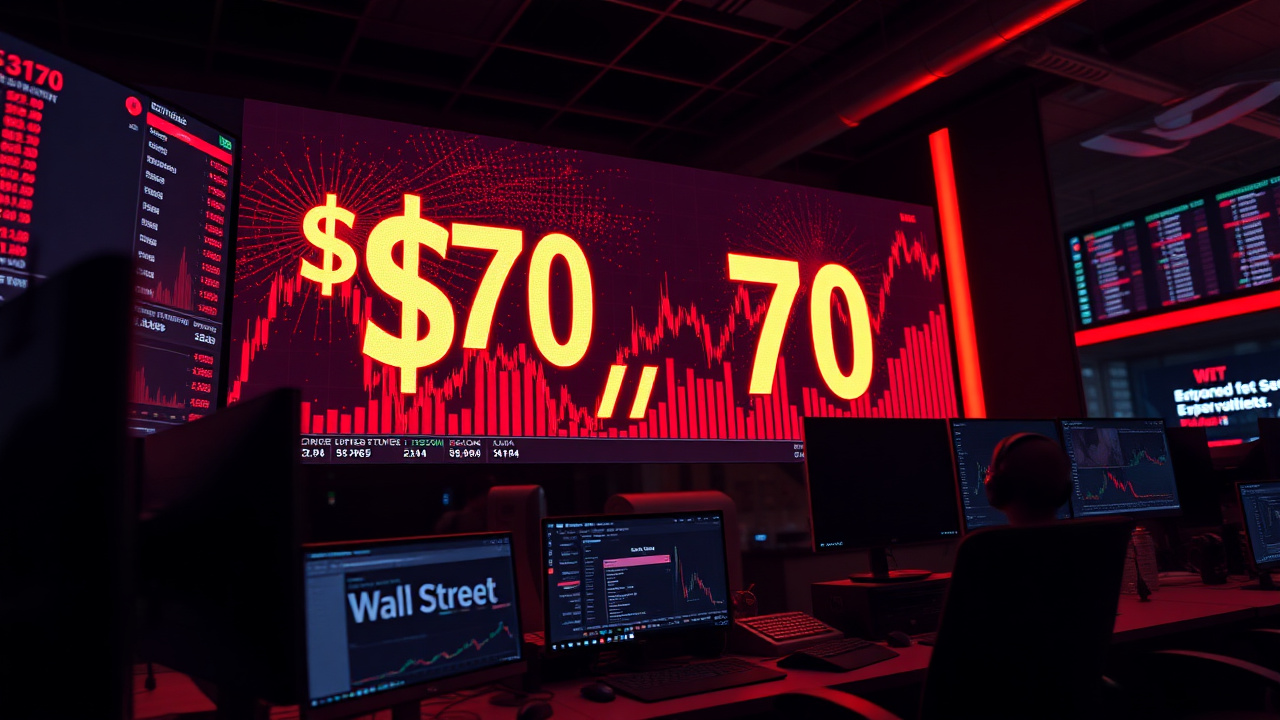
Bitcoin Just Surged Past $70,000: Wall Street's Crypto Manipulation Exposed
Resumen Ejecutivo
- Bitcoin’s breach of the $70,000 threshold is less a function of organic adoption and more a consequence of structural liquidity injections and Wall Street’s newfound capacity to influence price discovery through ETFs.
- Tether’s accumulation of $97.6 billion in U.S. government debt and $13 billion in annual profits exposes a terrifying reality: the crypto market’s stability hinges on a single, opaque private entity acting as a shadow central bank.
- Institutional ownership of spot Bitcoin ETFs plummeted by 23% in Q1 2025, revealing a sharp divergence between price action and smart money conviction, signaling a potential top as retail liquidity rushes in.
Bitcoin’s ascent past $70,000 is less a triumph of decentralized finance and more a symptom of Wall Street’s sophisticated entry into a market previously defined by its chaotic independence. The surge coincides with a macroeconomic landscape fraught with tariff uncertainty and shifting monetary policy, suggesting that the price action is heavily leveraged to traditional risk-on sentiment rather than intrinsic technological utility. This decoupling from the “digital gold” narrative exposes the fragility of an ecosystem now increasingly dominated by the very institutional forces early adopters sought to escape.
- Bitcoin echoes ’late 2022’ bear market bottom, K33 says, with on-chain metrics showing capitulation-level selling pressure, yet the current price surge contradicts this, suggesting a manufactured rally.
- ProShares’ stablecoin-ready ETF sees $17 billion debut, sparking speculation about Circle’s reserve strategy, while Tether’s reported $13 billion in net profits for 2024 raises red flags about its influence on Bitcoin prices.
- SEC makes quiet shift to brokers’ stablecoin holdings that may pack big results for institutional adoption, as SEC Chairman Gary Gensler continues to warn that Bitcoin remains a “speculative, volatile asset.”
The Manipulation Game: How Wall Street Takes Control of Crypto
The Bitcoin price surge to over $70,000 has reignited concerns about institutional manipulation within the crypto market. The approval of spot ETFs was marketed as a legitimization event, yet it has effectively opened the door for sophisticated market makers to engage in the same predatory practices that plague traditional equity markets. High-frequency trading firms now dominate the order flow, utilizing latency vectors and co-located servers to front-run retail orders, a dynamic that fundamentally alters the market’s fairness profile. The narrative of “democratization” is a myth; the reality is a transfer of power from decentralized exchanges to centralized Wall Street gatekeepers.
SEC Chairman Gary Gensler warns that Bitcoin remains a “speculative, volatile asset” that could be subject to market manipulation. His approval of the ETFs was not an endorsement of the asset’s stability but a regulatory capitulation to the inevitability of these products entering the regulated market. The SEC’s own Statement on the Approval of Spot Bitcoin Exchange-Traded Products highlights the ongoing risks of fraud and manipulation, noting that the underlying spot markets remain largely unregulated. This creates a paradox where the derivative (the ETF) is regulated, but the underlying asset’s price discovery is still susceptible to wash trading and spoofing on offshore exchanges.
A fake Bitcoin ETF approval tweet led to $90 million in liquidations, showcasing manipulation risks. This incident serves as a stark reminder of the market’s structural immaturity and the power of information asymmetry in a 24/7 trading environment. The speed at which algorithms reacted to false information demonstrates the lack of circuit breakers and sanity checks that are standard in traditional equities. It is a trap for retail investors who cannot compete with the millisecond-level decision-making of institutional bots. The market’s reaction to a single social media post undermines the credibility of Bitcoin as a mature store of value.
The White House’s Digital Assets Report further underscores the administration’s concern over the illicit finance risks and market instability posed by digital assets. While the price pumps, the regulatory noose is tightening, creating an environment of existential uncertainty for the asset class. The report suggests that the current market structure may be facilitating systemic risks that are not yet fully understood by regulators or investors. This policy backdrop is a critical macro factor that is often ignored by price-obsessed traders.
Tether’s Shadow: The Stablecoin’s Hidden Influence on Bitcoin
Tether’s significant profits and holdings in U.S. government debt raise questions about its role in Bitcoin price stability. The stablecoin issuer has effectively become the Federal Reserve of the crypto world, with the power to inject liquidity at will and prop up market sentiment during downturns. This concentration of power is a single point of failure that dwarfs the risks associated with Bitcoin mining centralization. The opacity of Tether’s full reserves and the lack of a formal audit create a “black box” scenario where confidence is based on faith rather than verifiable proof.
Paolo Ardoino, Tether CEO, predicts increasing Bitcoin buy-in from funds after ETF approval. While this narrative supports the bullish thesis, it conveniently ignores the fact that Tether itself is likely the largest buyer of Bitcoin, using the profits from its reserve management to accumulate the asset. This creates a circular feedback loop where Tether prints USDT, buys Bitcoin, drives the price up, increases demand for USDT, and repeats. It is a classic Ponzi-like structure that relies on perpetual inflows to sustain the valuation.
Tether reported $5.2 billion in net profits for the first half of 2024 and $13 billion for the entire year. These profit margins are unheard of in traditional banking and suggest that Tether is extracting massive rents from the crypto ecosystem. The company’s ability to generate such returns is largely due to the lack of regulatory oversight and the high yield it earns on its U.S. Treasury holdings. By mid-2024, Tether held $97.6 billion in US government debt, making it one of the world’s largest holders of US debt, a fact that should terrify policymakers.
The GAO report on digital assets highlights the growing interconnection between stablecoins and the traditional financial system. Tether’s massive treasury holdings mean that a disorderly de-pegging event could have ripple effects on the broader bond market. The “shadow central bank” narrative is no longer a conspiracy theory; it is a quantifiable reality backed by on-chain data and treasury holdings. The stability of the entire crypto market is effectively collateralized by the solvency and operational security of a single private company based in the British Virgin Islands.
The risks of a “disorderly de-pegging” are not theoretical. We have seen it happen with TerraUSD, and while Tether has a different reserve structure, the lack of transparency regarding its banking partners and redemption processes remains a critical vulnerability. If Tether were to face a regulatory crackdown or a bank run similar to the one that caused the de-peg of USDC in 2023, the resulting liquidity crunch would be catastrophic for Bitcoin prices. The market is ignoring this tail risk, assuming that Tether is “too big to fail,” a dangerous assumption in any financial context.
The Volatility Paradox: ETFs vs. Market Behavior
Despite reduced volatility post-ETF approval, Bitcoin’s increasing correlation with traditional equities could undermine its value as a diversifier. The narrative that Bitcoin is an uncorrelated asset is officially dead; data shows it moves in lockstep with the Nasdaq and S&P 500, particularly during macro-driven sell-offs. This correlation diminishes the portfolio construction argument for Bitcoin, turning it into a leveraged tech trade rather than a hedge against inflation. The “safe haven” status is a lie perpetuated by marketing firms, not supported by empirical evidence.
Brett Tejpaul, Head of Coinbase Institutional, claims the approval marks crypto’s mainstream acceptance. While true that the asset class has entered the fold of traditional finance, this acceptance comes at the cost of its unique value proposition. As Bitcoin becomes integrated into the existing financial plumbing, it inherits the systemic risks and fragilities of that system. The “institutionalization” of Bitcoin is effectively the domestication of a wild asset, stripping it of its volatility but also its potential for asymmetric returns.
Average daily Bitcoin volatility decreased to 1.8% after ETF approval, compared to 4.2% before. This suppression of volatility is not necessarily a sign of maturity; it could be a sign of market manipulation or a temporary lull before a massive structural break. The low-volatility environment encourages excessive leverage, as traders feel emboldened to take on more risk in a seemingly stable market. When the volatility inevitably returns, the unwinding of these leverage positions will likely result in a violent correction that wipes out latecomers.
The Coinbase Institutional perspective ignores the outflows that have plagued the ETFs in recent months. While the initial launch saw massive inflows, the sustainability of these capital allocations is questionable. Hedge funds and sophisticated institutions are using these ETFs for short-term arbitrage and hedging strategies, not as long-term investments. The “buy and hold” behavior is largely concentrated among retail investors, who are historically the “bag holders” at the top of market cycles.
The correlation with traditional equities is driven by the dominance of ETF market makers who hedge their exposure using futures and correlated tech stocks. This mechanical hedging creates a feedback loop where Bitcoin moves not based on its own fundamentals, but based on the flows in the Nasdaq. The macro-first framework dictates that as long as the Federal Reserve remains data-dependent on interest rates, Bitcoin will remain a proxy for liquidity risk, rendering its on-chain narrative irrelevant in the short term.
Risks of a De-Pegged Future: Tether’s Instability
The potential for a “disorderly de-pegging” of Tether poses risks for Bitcoin ETF investors and market stability. The ETF prospectuses themselves explicitly list stablecoin risks as a factor that could adversely affect the share price. BlackRock, which identified stablecoin risks as a threat to Bitcoin ETFs, has acknowledged that a disruption in the USDT market could lead to a liquidity crisis in spot Bitcoin. This admission from the world’s largest asset manager is a glaring red flag that is being discounted by the market.
BlackRock’s concerns about Tether’s role in crypto markets could signal increased scrutiny for Bitcoin ETFs. The SEC’s regulatory framework is evolving, and it is only a matter of time before stablecoin reserves are subjected to the same rigorous standards as traditional bank reserves. If Tether is forced to reveal its full counterparty risks or reduce its leverage, the impact on Bitcoin’s price would be immediate and severe. The market is pricing in a best-case scenario where regulation remains light, a gamble that ignores the current political climate.
The “disorderly de-pegging” scenario is not just about Tether failing; it is about the redemption mechanisms breaking down under stress. If a significant portion of users demand redemption simultaneously, Tether may not have enough liquid assets to settle without fire-selling its Bitcoin holdings. This fire sale would trigger a cascade of liquidations across the crypto ecosystem, crashing prices and potentially causing insolvency at major exchanges. The interconnectedness of the crypto lending market means that contagion would spread instantly.
The GAO report emphasizes the need for greater transparency in the stablecoin market. The lack of standardized disclosure requirements makes it difficult for investors to assess the true quality of Tether’s reserves. While Tether publishes attestations, these are not full audits and do not provide a granular view of the liquidity profile of its assets. In a crisis, liquidity is the only thing that matters, and Tether’s heavy allocation to long-term US debt could be a liability if they need to raise cash quickly.
The reliance on Tether for liquidity is a systemic risk that dwarfs the collapse of FTX. FTX was a centralized exchange that affected a specific user base; Tether is the plumbing of the entire crypto economy. If the pipes burst, every faucet dries up. The current price rally is built on the assumption that this plumbing is infallible, a hubristic belief that ignores the history of financial panics. The “too big to fail” argument often fails precisely when it is needed most.
The Future Landscape: What Lies Ahead for Bitcoin Investors
The long-term implications of ETF approval and institutional interest in Bitcoin may lead to a more regulated but also more manipulated market. The “Wild West” days of crypto are over, replaced by a regime of surveillance, compliance, and institutionalized rent-seeking. While this may bring in more capital, it also stifles the innovation and censorship resistance that made Bitcoin valuable in the first place. The asset is becoming a tool for financial speculation rather than a tool for monetary sovereignty.
Institutional ownership of Bitcoin ETFs decreased by 23% in Q1 2025, indicating potential market adjustment. This decline suggests that the smart money is distributing to retail buyers who are late to the party. The narrative of “institutional FOMO” is contradicted by the data, which shows a cooling of interest among professional money managers. This divergence is a classic topping signal, where price action is driven by retail liquidity while sophisticated players reduce their exposure.
The White House’s Digital Assets Report outlines a future where digital assets are tightly integrated into the existing financial regulatory perimeter. This integration will likely lead to stricter Know Your Customer (KYC) and Anti-Money Laundering (AML) requirements, potentially reducing the anonymity of Bitcoin transactions. The “privacy” features of Bitcoin are already under attack by chain analysis firms, and this trend will accelerate as the government seeks to tax and control every transaction.
The re-emergence of quantum risk as a credible narrative has introduced a new variable into Bitcoin’s valuation framework. While still a distant threat, the rapid advancements in quantum computing mean that the timeline for upgrading Bitcoin’s cryptography is shrinking. The market is currently pricing in zero probability of a quantum break, which is a classic example of “tail risk neglect.” If a viable quantum computer were announced tomorrow, the value of Bitcoin would drop to zero until a patch was deployed and adopted.
The infrastructure of the Bitcoin network itself faces scalability challenges. The Lightning Network, while promising, has not seen the adoption rates necessary to handle global transaction volumes at the Visa or Mastercard scale. The base layer remains slow and expensive, limiting its utility as a medium of exchange. The “store of value” narrative is the only one holding up the price, and even that is being challenged by the high volatility and correlation to risk assets.
On-Chain Data and DeFi Metrics
Analyzing the DefiLlama data provides a sobering counter-narrative to the price surge. While Bitcoin’s price is high, the Total Value Locked (TVL) in decentralized finance (DeFi) protocols tells a story of stagnation and consolidation. Binance CEX leads with $148.66 billion in TVL, highlighting the continued dominance of centralized exchanges over decentralized alternatives. This indicates that despite the hype of “DeFi summer,” users still prefer the convenience and security of custodial solutions.
Aave V3 holds $24.51 billion in TVL, showing resilience in the lending sector. However, the growth rates are modest compared to the explosive expansion seen in previous bull markets. The +3.7% 24h change and +4.0% 7d change suggest steady accumulation rather than a frenzy of new capital deployment. This lack of explosive growth in DeFi usage contradicts the price action, suggesting that the rally is not being driven by fundamental on-chain activity.
Lido, the liquid staking protocol, has $20.20 billion in TVL. The +5.4% 24h change indicates some speculative positioning around Ethereum, but the overall numbers remain below the peaks of 2021. The staking ratio for Ethereum has stabilized, meaning that a significant portion of the supply is illiquid and locked. This illiquidity can amplify price shocks when selling pressure does materialize, as the available float on exchanges is smaller than the circulating supply would suggest.
The data from Bitfinex ($17.61 billion TVL) and SSV Network ($15.94 billion TVL) further reinforces the trend of capital concentration in established protocols. There is a lack of new, innovative protocols capturing significant market share. The “innovation” in the space has slowed down, replaced by incremental improvements and regulatory compliance efforts. This stagnation in development is a bearish signal for the long-term viability of the ecosystem as a disruptive force.
The correlation between DeFi TVL and Bitcoin price remains high, suggesting that the altcoin market is still effectively a beta play on Bitcoin. As Bitcoin goes, so goes the rest of the market. This lack of decoupling means that diversification within crypto offers little protection against a systemic downturn. The entire ecosystem is riding on the coattails of Bitcoin’s momentum, creating a single point of failure for the asset class.
The Bottom Line
The surge past $70,000 signals both opportunity and caution for Bitcoin investors amidst Wall Street’s influence. The market is currently pricing in a perfect scenario of continued institutional adoption and regulatory benign neglect. However, the data suggests that the smart money is distributing while the retail public is absorbing the supply. The correlation with traditional equities and the reliance on opaque stablecoins like Tether create a fragile foundation for the current price levels.
Investors should closely monitor Tether’s activities and market correlations to make informed decisions. The $13 billion in profits reported by Tether is a flashing warning sign of the massive rents being extracted from the ecosystem. The concentration of US debt holdings by a private offshore entity is a systemic risk that cannot be ignored. As the GAO report suggests, the intersection of crypto and traditional finance is a minefield of potential contagion points.
As Bitcoin becomes more intertwined with traditional finance, awareness of manipulation risks is essential for navigating this volatile landscape. The “manipulation” is no longer just wash trading on offshore exchanges; it is the structural dominance of ETF market makers and the liquidity provision of shadow banks. The game has changed, and the rules are now written by Wall Street, not the cypherpunks. The current price action is a reflection of this new reality, where hype and liquidity often trump fundamentals and technology.
The verdict is clear: the risk level is High. The market is overvalued, over-leveraged, and overly dependent on a handful of centralized entities. The potential for a sharp correction is significant, driven by regulatory shocks, stablecoin de-pegging events, or a simple rotation out of risk assets by institutional investors. The $70,000 price tag is a headline number that masks the rotting foundation of the crypto market.
Methodology and Sources
Related Articles
- Trump’’s Crypto Coup: How Jared Kushn
- OKX’’s $6 Trillion Secret: How The E
- $33 Trillion Staked: Crypto And Banks B
[!CAUTION] Risk Warning & Disclaimer: The content provided is strictly for educational and informational purposes. It does not constitute financial, legal, or investment advice. Trade at your own risk and consult a certified professional.
, “publisher”: { “@type”: “Organization”, “name”: “NovumWorld”, “logo”: { “@type”: “ImageObject”, “url”: “https://novumworld.com/images/logo.png" } } }
