Nvidia's $45.8 Billion Obligation Sparks 200% Earnings Growth in KOSPI Stocks
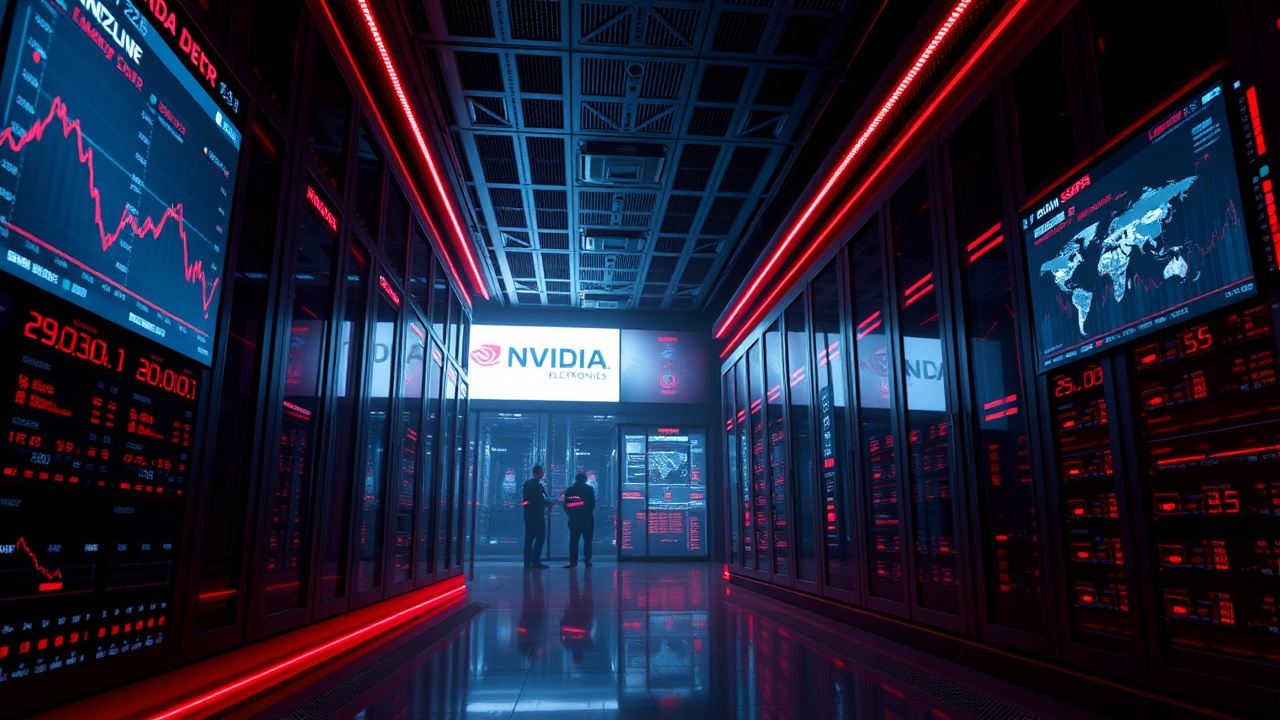
Executive Summary
- Nvidia’s $45.8 billion supply chain obligation is pushing the KOSPI index towards an expected earnings growth of over 200% in the next year.
- Samsung Electronics shares surged nearly 13% on May 6, 2026, fueled by the optimism surrounding AI-driven demand for semiconductors.
- Investors should prepare for potential volatility as concerns over an AI bubble and memory chip shortages loom large.
The KOSPI’s projected 200% earnings growth is a fragile construct built on Nvidia’s desperate $45.8 billion gamble to corner the global memory supply. This isn’t a market rally driven by organic innovation or consumer adoption. It is a financial engineering maneuver where Jensen Huang is effectively buying the entire output of South Korea’s HBM fabs to starve competitors. The result is a temporary scarcity bubble that inflates South Korean equities while masking the severe physical limits of the semiconductor supply chain.
- Nvidia’s purchase obligations hit $45.8 billion as of Q2 FY2026, a 50% increase in six months, signaling a massive inventory hoard that distorts market availability.
- Samsung Electronics and SK Hynix have more than doubled in value this year, yet over 600 stocks in the 835-member KOSPI have declined during the same period.
- Global HBM spend is projected to grow 58% YoY in 2026 to reach $54.6 billion, but manufacturing capacity remains the critical bottleneck.
The $45.8 Billion Chip Choke Point
Nvidia’s staggering $45.8 billion in purchase obligations represents a strategic choke point rather than simple demand. This figure, up 50% in six months, indicates that Nvidia is pre-paying and securing supply chains to lock out rivals like AMD and Intel. The company is executing a “strategic capacity capture,” ensuring that every available unit of High Bandwidth Memory (HBM3e) is reserved for Blackwell (B200) and Hopper (H100) architectures. This creates an artificial scarcity that drives up the stock prices of memory manufacturers while simultaneously creating a barrier to entry for anyone else trying to train large language models (LLMs).
The technical reality is that modern Transformer architectures are memory-bound. An H100 SXM5 GPU boasts 80GB of HBM3 memory delivering 3.35 TB/s of bandwidth. Without this specific memory bandwidth, the massive parameter counts of models like Llama-3 (405B) or GPT-4o are useless. Nvidia’s $45.8 billion obligation is essentially a tax on the AI industry, forcing every hyperscaler to pay the Nvidia premium just to access the necessary memory throughput. This dynamic turns the KOSPI rally into a derivative of Nvidia’s monopoly power rather than a reflection of broad economic health in South Korea.
The bottleneck is not just in the memory dies themselves but in the advanced packaging required to stack them. TSMC’s CoWoS (Chip-on-Wafer-on-Substrate) capacity is the limiting factor, with lead times stretching to six months. Nvidia’s massive financial commitment allows them to jump the queue, leaving other customers to wait. This creates a distorted market where the availability of compute is determined by balance sheet strength rather than technical merit. The KOSPI is rising because South Korea owns the foundries for the bottleneck, but this is a precarious position dependent entirely on a single customer’s aggressive procurement strategy.
The Illusion of Endless Growth
The surge in Samsung Electronics and SK Hynix shares—nearly 13% and 10% respectively on a single day in May—creates a dangerous illusion of endless growth. This optimism ignores the cyclical nature of the memory market, which has historically been characterized by boom-and-bust cycles driven by overcapacity. The current rally assumes that AI-related capital expenditures will continue to compound indefinitely, ignoring the law of large numbers. As reported by BNN Bloomberg, worries about inflation and war are already hitting broader markets, suggesting that the AI trade is an isolated bubble.
Underlying supply chain issues are already undermining the sustainability of this rally. Kim Jae-june, Samsung’s Memory Business Executive VP, admitted that supply shortages are likely to worsen because capacity expansion is limited in 2026 and 2027. Building new fabrication lines (fabs) takes years and costs tens of billions of dollars. The current demand spike is outpacing the physical ability to build new cleanrooms. This means the “growth” investors are pricing in now relies on technology that doesn’t exist yet. The market is discounting future earnings based on capacity that is merely a blueprint on an engineer’s desk.
Furthermore, the cost of inputs is skyrocketing, which threatens the unit economics of AI inference. DDR5 prices increased by 263% in just two months, jumping from $6.84 to $24.83 per chip. If memory costs continue to climb, the cost per token for running models like Claude 3.5 Sonnet or Gemini 1.5 Pro will become prohibitive for all but the largest tech giants. This kills the “democratization of AI” narrative and suggests that the market for these chips might saturate faster than expected. If the price of compute gets too high, the ROI for AI applications collapses, and the demand for chips evaporates.
The Hidden Risks of AI Dependency
The overwhelming focus on AI-related stocks is masking significant structural risks in the South Korean economy. Michael Burry, famed investor of “The Big Short,” has explicitly warned that technology stocks are in a bubble. He advised investors to reduce exposure, noting that the current market frenzy resembles past manias disconnected from fundamental reality. The KOSPI’s performance is dangerously narrow; while the index breaks records, more than 600 stocks within the index are declining. This is a classic sign of a market top driven by momentum trading rather than broad-based economic strength.
The dependency on a single sector creates a systemic risk for the entire South Korean market. If AI training demand slows—or if Nvidia’s dominance is challenged by custom silicon like Google’s TPU v5 or Amazon’s Trainium—the South Korean economy faces a severe shock. The concentration of gains is alarming, with AI-related stocks accounting for a disproportionate amount of market capitalization. This lack of diversification means that any negative news regarding AI adoption, chip yields, or regulatory crackdowns could trigger a massive sell-off. The market is pricing in perfection, leaving no room for error.
There is also the issue of “overfitting” in the financial models. Analysts are projecting earnings growth of 200% based on extrapolations of current HBM pricing. However, HBM commands premium margins specifically because it is scarce. Once Micron and other competitors ramp up production and yields stabilize, the price discipline will likely collapse. The memory market is notoriously commoditized; the high margins of today are the low margins of tomorrow. Investors betting on 200% growth are assuming that the current shortage dynamics will persist forever, which contradicts 50 years of semiconductor history.
The Supply Chain Realities
Geopolitical tensions and manufacturing constraints are creating a “perfect storm” that could disrupt South Korean semiconductor production. SK Hynix announced that HBM demand will exceed its manufacturing capacity for the next three years. While this sounds like a good problem to have, it highlights the fragility of the supply chain. A single disruption—be it a natural disaster, a power outage, or a geopolitical escalation—could halt global AI progress. The reliance on a specific geographic region for a critical component is a strategic vulnerability for the entire tech industry.
The situation is exacerbated by the complexity of HBM manufacturing. Producing HBM requires Through Silicon Via (TSV) technology, which involves stacking memory dies vertically and connecting them with microscopic copper pillars. The yield rates for this process are notoriously low. If a single defect occurs in one layer of the stack, the entire expensive component must be discarded. This limits how quickly production can scale, regardless of how much capital is thrown at the problem. Nvidia’s $45.8 billion obligation cannot repeal the laws of physics; it can only pay for priority access to the limited supply that exists.
Furthermore, the “sovereignty” of the supply chain is an illusion. While South Korea manufactures the memory, the equipment and materials come from a global network. The photoresists, etching tools, and deposition machines often come from Japan, the US, and Europe. Any trade friction or export controls in these regions can immediately stop production. The narrative of South Korean dominance ignores this deep interdependence. The KOSPI rally assumes a frictionless global trade environment, which is increasingly unlikely in the current political climate.
The Uncomfortable Truth
The KOSPI’s rapid ascent is a reflection of financial engineering rather than industrial prowess. The market is reacting to Nvidia’s balance sheet, not South Korea’s economic fundamentals. This creates a “trap” for retail investors who see the index hitting 7,000 or 8,000 and assume the broader economy is booming. In reality, the wealth is concentrated in the hands of a few chaebols, while the underlying economy struggles with structural issues like low birth rates and an aging workforce. The stock market has decoupled from the real economy.
The power consumption of these new chips presents another uncomfortable truth that the market is ignoring. A single B200 GPU can consume over 1000W of power. Data centers are struggling to find enough electricity to run these clusters, let alone the cooling required to prevent thermal throttling. The “infrastructure” for AI is not just chips; it is the grid. If the power cannot be delivered, the chips cannot run. This physical limit acts as a hard cap on how much AI compute can actually be deployed, regardless of how many HBM modules Samsung produces.
Finally, the “AI Revolution” may be overhyped in terms of immediate utility. While models like GPT-4o and Claude 3.5 Sonnet are impressive, the revenue generated by these applications has yet to justify the massive capital expenditures. There is a growing disconnect between the cost of infrastructure (inflated by the KOSPI rally) and the revenue generated by AI applications. If this gap does not close soon, the investment bubble will burst. The KOSPI is pricing in a future where AI is as ubiquitous as electricity, but the current reality is that AI is mostly a tool for generating marketing copy and coding snippets.
The Future: A Volatile Asymmetry
The KOSPI rally is built on a foundation of sand, vulnerable to shifts in sentiment and supply chain realities. While the short-term momentum driven by Nvidia’s buying spree is undeniable, the long-term stability is highly questionable. The market is ignoring the cyclicality of memory and the physical limits of power and packaging. As noted in recent market analysis, the dominance of GPUs and TPUs is fading as bottlenecks shift to other components.
Investors are ignoring the warnings of experts like Michael Burry and the internal warnings from Samsung executives about capacity limits. The belief that “this time is different” is a hallmark of every financial bubble. The 200% earnings growth projection is a mathematical extrapolation that assumes a best-case scenario for the next two years. It does not account for the risk of a global recession, a geopolitical crisis in the Taiwan Strait, or a simple failure of AI models to generate meaningful ROI at scale.
The narrowness of the rally is the most damning indicator. When an index rises to record highs while the majority of its components decline, it is a sign of speculative excess. The “smart money” is likely positioning for a correction, even as they publicly cheer the rally. The KOSPI is being used as a liquidity vehicle for global AI bets, stripping it of its connection to the South Korean economy. This decoupling cannot last indefinitely.
The semiconductor saga is far from over, but the easy money has been made. The next phase will be defined by volatility, margin compression, and a brutal reckoning between the hype of AGI and the reality of power bills and balance sheets. The KOSPI is currently a proxy for Nvidia’s dominance, and that is a dangerous position for any national index to occupy. The real winners will not be the memory manufacturers, but the companies who figure out how to make AI profitable without burning through cash and silicon at an unsustainable rate.
The KOSPI is a leveraged bet on the physics of memory packaging, and physics is unforgiving.
Methodology and Sources
Related Articles
- Perplexity’’s $200 Computer AI: 80% Of Companies
- The Parenthood Happiness Paradox: 36% Of Parents Are Not Happier Than Childless Adults
- Digital Elites: Saviors or Soci
, “publisher”: { “@type”: “Organization”, “name”: “NovumWorld”, “logo”: { “@type”: “ImageObject”, “url”: “https://novumworld.com/images/logo.png" } } }
